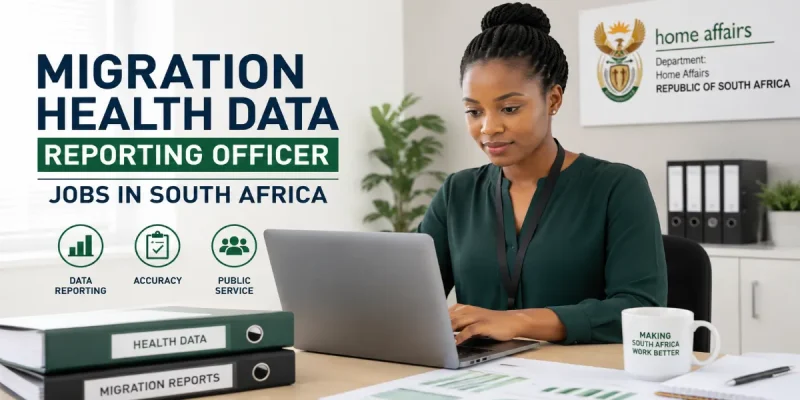

South Africa remains one of Africa’s most active migration corridors and in 2026, the demand for skilled professionals who can collect, analyse, and report on migrant health data has never been higher. Organisations like the International Organization for Migration (IOM), the World Health Organization (WHO), and the national Department of Health are all actively expanding their migration health units. If you’ve got a background in public health, epidemiology, or health informatics, this is a role worth taking seriously.
💰 Salary & Compensation (2026)
Average Annual Salary
R 580,000
IOM, WHO & DOH salary bands · South Africa 2026
Monthly Range
R 35,000 – R 80,000
Senior/UN-graded roles can exceed R 80,000/month
Junior Officer
R 35,000
per month
Mid Level (3–6 yrs)
R 52,000
per month
Senior Officer (7+ yrs)
R 80,000
per month
Annual Bonus
R 30k – R 90k
performance-based
🌍 International & Remote Opportunities
Migration health data work isn’t confined to South Africa’s borders and that’s genuinely one of the most exciting things about this career path. The IOM operates in 175 countries. WHO’s Regional Office for Africa deploys officers across the continent and beyond. A strong track record in South Africa regularly opens doors to regional and global postings, often with significantly higher USD or EUR-denominated salary packages that make the local figures look modest by comparison.
Remote work has become a real option in this sector since 2022. Several IOM data reporting contracts are now structured as remote or hybrid particularly those focused on dashboard development, DHIS2 administration, and regional data compilation. If you’re based in South Africa working remotely for an international organisation, your package can realistically reach USD 45,000–85,000 per year, which at current exchange rates translates to roughly R 825,000–R 1.56 million annually. That’s a significant uplift from local government or NGO rates.
UNHCR, PEPFAR-funded programmes, and the Global Fund also hire migration health data professionals in South Africa, often through implementing partners like Right to Care, Anova Health, and the Aurum Institute. These roles tend to be locally contracted but carry competitive packages by South African NGO standards, with the added advantage of working within globally recognised health programmes that build your international CV fast.
For those open to regional mobility, the SADC health framework creates ongoing demand for migration health data professionals across Lesotho, Eswatini, Zimbabwe, and Mozambique all countries with significant cross-border migration flows with South Africa. Regional postings typically include housing allowances, hardship supplements, and comprehensive health coverage on top of a solid base salary.
💡 Pro Tip for Job Seekers
Register your profile on the IOM iRecruitment portal (careers.iom.int) and the UN Careers platform (careers.un.org). Set keyword alerts for “migration health,” “health data,” and “MHAC.” These roles fill within 2–3 weeks of posting don’t wait until you see them shared on LinkedIn.
🏢 Top Hiring Organizations
📋 Requirements & Qualifications
This isn’t an entry-level role you can bluff your way into. IOM and WHO are very specific about what they need and the competition is real. Here’s a breakdown of what strong candidates actually bring to the table in 2026.
1
Degree in Public Health, Epidemiology, or Health Informatics
A Bachelor’s is the minimum but most competitive candidates hold an MPH, a Master’s in Epidemiology, or a postgraduate qualification in Health Information Management. South African universities like Wits, UCT, Stellenbosch, and UKZN are well-recognised by international health organisations. A specialist qualification in global health or migration studies is a genuine differentiator that gets noticed.
2
2–5 Years of Health Data or M&E Experience
Direct experience in health data collection, monitoring and evaluation, or health information systems is essential. Experience specifically within migration health, refugee health, or border health programmes is strongly preferred. Candidates who’ve worked on PEPFAR reporting cycles, Global Fund grant milestones, or district health information systems tend to perform well in these interviews.
3
DHIS2 Proficiency & Health Information Systems
DHIS2 is non-negotiable it’s South Africa’s national health data platform and the backbone of most public health reporting in the country. Beyond DHIS2, experience with REDCap for data collection, OpenMRS for clinical records, or IOM’s proprietary MiMOSA system for migration health assessments will immediately separate your application from the pile.
4
Statistical Analysis & Data Visualisation
Advanced Excel is the bare minimum. Proficiency in at least one proper statistical tool R, STATA, or SPSS is typically required in job descriptions. The ability to visualise data clearly in Power BI or Tableau is increasingly expected in 2026. If you can build a clean, automated dashboard pulling live data from DHIS2, you’re genuinely uncommon and hiring managers know it.
5
Understanding of Migration Health Frameworks
Familiarity with IOM’s Migration Health Assessment processes, the International Health Regulations (IHR 2005), and South Africa’s National Health Act is expected. Understanding how migration intersects with communicable disease surveillance particularly TB, HIV, and cholera is especially relevant given South Africa’s significant cross-border disease burden from Lesotho, Zimbabwe, and Mozambique.
6
Strong Written Communication & Report Writing
A significant part of this job is writing situation reports, donor reports, technical briefs, and policy recommendations that different audiences will actually read and use. You need to present the same dataset very differently for a technical epidemiologist versus a government director versus an international donor. A writing sample is worth including with your application; it makes a real difference.
7
South African Citizenship or Valid Work Authorisation
Government and many NGO roles require South African citizenship or permanent residency. IOM and UN system roles are often open to other nationalities holding valid South African work permits. Always check the specific citizenship requirement in the job description it varies considerably between organizations, funding sources, and even between roles within the same organization.
⚡ In-Demand Technical Skills
The technical toolkit for this role has evolved fast over the past few years. Organizations now expect data competency that goes well beyond spreadsheets. Here’s what’s genuinely in demand across hiring organizations in South Africa in 2026.
🖥️ Health Information Systems
DHIS2 is the national backbone for health data in South Africa not knowing it puts you at a real disadvantage. REDCap and KoBoToolbox are widely used for field data collection in migrant health assessments and border health screenings. IOM’s MiMOSA system is used specifically for migration health assessment records and is something candidates typically learn on the job, but prior awareness of its purpose is valued at interview.
📊 Data Analysis & Visualisation
R is the statistical language of choice across South Africa’s academic and NGO health sector; STATA is preferred in many PEPFAR-funded programmes. Power BI is increasingly used for live dashboards at provincial and national DOH level. If you can build automated reports that pull directly from DHIS2 into a Power BI dashboard, you’re solving a real pain point that most organisations currently handle manually.
🗺️ GIS & Reporting Frameworks
Geographic mapping of migration health data crossing points, disease incidence corridors, health service access gaps is a growing requirement in 2026 job specs. QGIS is the free tool most South African NGOs use; ArcGIS features in more resource-heavy government and UN contexts. Familiarity with PEPFAR’s DATIM reporting platform is particularly valued in USAID and CDC-funded programmes operating in South Africa.
📍 Job Locations
Pretoria
IOM · WHO · DOH HQ
Most openings
Johannesburg
NGO Partners · PEPFAR Programmes
Active hiring
Cape Town
Western Cape DOH · Research NGOs
Select roles
Remote / Hybrid
IOM & UN contract roles
USD salary possible
🎁 Benefits & Perks
The benefits package varies considerably between a UN agency role, a government post, and an NGO implementing partner but all three tiers offer meaningful perks that go well beyond the monthly salary figure.
🏥
Comprehensive Medical Aid
UN agency roles include full family medical coverage through CIGNA or Discovery Health, often covering dependants at no additional cost. Government posts come with GEMS (Government Employees Medical Scheme) at subsidised premium rates. NGO and implementing partner roles typically subsidise 50–100% of a Discovery or Bonitas plan for the employee.
✈️
Travel & Field Allowances (DSA)
Field-based roles carry daily subsistence allowances whenever you’re deployed away from your duty station. IOM DSA rates in South Africa typically run at USD 180–250 per day for international staff and senior national officers. Local staff receive government or organisational per diem rates of R 800–1,500 per day for approved field work.
📚
Professional Development & Training
IOM covers conference attendance and relevant short courses for its staff. PEPFAR-implementing partners regularly fund STATA, R, and DHIS2 training for data officers. Government posts may qualify for PERSAL-linked bursaries for postgraduate study a meaningful benefit for those working towards an MPH or doctoral qualification.
🏦
Pension & Provident Fund
Government roles fall under GEPF one of the most stable defined-benefit pension funds in Africa. NGO and UN roles typically contribute 10–15% of basic salary to a provident fund, with employer contributions often matching employee contributions. For longer-term roles, this represents substantial retirement wealth accumulation on top of a competitive base salary.
🌍
International Exposure & Career Mobility
A posting with IOM or WHO in South Africa genuinely opens doors to SADC regional assignments, East Africa deployments, and Geneva headquarters roles. Each international posting builds a UN/INGO CV that’s valuable globally. High performers in South Africa consistently move into regional advisory or senior data management roles within 3–5 years.
🕑
Generous Leave & Flexible Work
UN system roles carry 30 calendar days of annual leave per year significantly more than South Africa’s statutory 15 working days. Many NGO roles now offer hybrid arrangements with 2–3 days remote per week. Government posts follow the DPSA leave framework, which includes study leave and special leave categories beyond standard annual leave entitlements.
📨 How To Apply
Applications for migration health data roles are more competitive than most public health positions partly because the pool of genuinely qualified candidates is smaller than it looks. These five steps will put you significantly ahead of most applicants.
Use Each Organisation’s Own Application System
IOM uses its iRecruitment portal (careers.iom.int) uploading a CV file alone isn’t enough; you need to complete their structured online profile in full. WHO uses the inspira platform. Government posts require the Z83 form and the DPSA e-Recruitment system. Each platform has its quirks, so start the application profile at least 48 hours before the deadline rather than on the day.
Write a Targeted, Specific Cover Letter
Generic cover letters don’t cut it here. Name the specific data systems you’ve used DHIS2, REDCap, STATA and the health programmes you’ve contributed to. Show you understand South Africa’s particular migration health context: the cross-border TB burden, the Beitbridge and Lebombo crossing volumes, the challenges of health service access for undocumented migrants. One well-targeted paragraph beats three generic ones.
Include a Data Portfolio or Work Sample
A clean dashboard screenshot, a sanitised data report, or a brief analytical summary you’ve produced (with any confidential information removed) immediately differentiates you from candidates who only describe their skills. If you have public code on GitHub, include the link. Concrete evidence of your actual analytical output matters enormously in data-focused roles don’t underestimate its impact.
Prepare Referees in Advance
IOM, WHO, and most PEPFAR-funded roles conduct reference checks as part of the process often before the final interview stage. Let your referees know you’re applying before you submit so they’re not caught off-guard by an unexpected email from an HR department. A supervisor from a UN or international NGO context is the most valuable reference type for these specific roles.
Monitor Multiple Platforms at Once
These roles are posted across several channels simultaneously and close fast often within 2 weeks. Set up keyword alerts on LinkedIn, the IOM iRecruitment portal, the DPSA e-Recruitment system, ReliefWeb, and Devex. Missing a short application window is the most common reason qualified candidates don’t get considered. Alerts take five minutes to set up and save you from exactly that scenario.
Apply on These Platforms:
📅 Posted
June 2026 (Active)
💼 Type
Full-time · Fixed-term
📊 Openings
15+ Positions
🚀 Ready to Make Your Move?
Migration health data work is genuinely meaningful and in 2026, it’s also a career with real international traction. Apply on multiple platforms, tailor every application, and don’t underestimate the impact of a strong data portfolio on your chances.
Leave a Comment