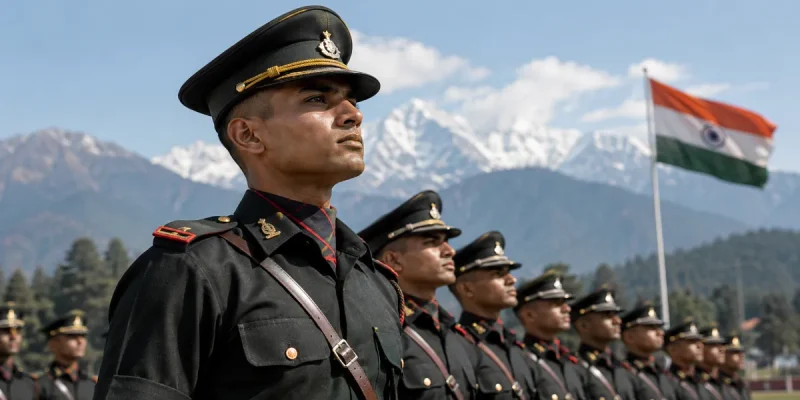

The Indian Army Technical Graduate Course (TGC) is one of the most prestigious officer entry routes for engineering graduates who want to serve the nation. TGC 144 is scheduled for a July 2026 intake at the Indian Military Academy (IMA), Dehradun. If you hold a BE/B.Tech degree in an eligible engineering discipline and want a career that combines technical expertise with leadership, service, and one of the most respected professions in India, this is the notification you’ve been waiting for. Read this guide carefully the selection process is rigorous, and preparation starts long before the application window opens.
📅 Important Dates & Notification Schedule
Course Commencement
July 2026
Indian Military Academy (IMA) · Dehradun
Notification Release
Jan–Feb 2026
Approx. Schedule
Application Window
~14 Days
After notification
SSB Interviews
Mar–May 2026
After shortlisting
Course Start
July 2026
IMA Dehradun
💰 Salary & Pay Package (7th Pay Commission)
Starting Monthly Emoluments
₹80,000+
Including all allowances · Lieutenant rank on commission
Basic Pay (Level 10)
₹56,100 – ₹1,77,500
Pay Matrix · 7th Central Pay Commission
Basic Pay (Lt)
₹56,100
per month
MSP (Military Service Pay)
₹15,500
per month
DA + HRA + Allowances
₹8,000+
variable by posting
Total CTC (approx.)
₹80,000–₹1L
per month
🎖️ What Is TGC & Why It’s a Prestigious Entry Route
The Technical Graduate Course (TGC) is specifically designed for engineering graduates who want to serve in the Indian Army as Commissioned Officers. Unlike NDA (which selects candidates straight after school) or CDS (which is open to all graduates), TGC is exclusively for engineers which makes it one of the most technically focused officer entry routes available. TGC officers are commissioned into the Corps of Engineers, Corps of Signals, Army Service Corps, Army Ordnance Corps, Electrical & Mechanical Engineers (EME), and the Army Education Corps, depending on vacancies and merit.
A TGC commission is a Short Service Commission (SSC) for an initial period of 10 years, extendable up to 14 years. Candidates who demonstrate exceptional performance during the SSC period may be considered for Permanent Commission (PC), which is a career-long commission with full pension benefits. In recent years, SSC officers in technical branches have had improved PC conversion rates making TGC a potentially permanent career choice, not just a 10-year stint, for the most capable candidates.
Training at IMA Dehradun is rigorous and transformative. The 1-year (approximately) training programme covers military tactics, weapon handling, physical conditioning, leadership development, and technical military subjects relevant to your allocated arm or corps. Cadets are commissioned as Lieutenant upon successful completion of training. The camaraderie, discipline, and professional development received at IMA is widely regarded as unmatched in any other professional training programme in India.
Beyond the salary, TGC officers enjoy a lifestyle and career that civilian employment simply cannot replicate free accommodation in cantonment areas, subsidised medical care for self and family through ECHS, access to Army welfare schemes, CSD canteen facilities, adventure training opportunities, and the singular honour of wearing the uniform of the Indian Army. For engineers who want their technical degree to serve a purpose larger than a corporate career, TGC is the answer.
⚠️ Important Notice
Always verify TGC 144 notification details directly from the official website joinindianarmy.nic.in before applying. Application dates, vacancy numbers, and eligibility criteria are confirmed only in the official notification. This guide is based on the pattern of previous TGC courses and is for informational purposes. The official notification is the authoritative source.
📋 Eligibility Criteria
The eligibility criteria for TGC 144 follow the established pattern of previous TGC courses. Here is a detailed breakdown of what you need to qualify before applying.
1
Nationality
Candidates must be Indian Citizens. Subject to the Citizenship Act, persons of Indian Origin or Subject of Nepal/Bhutan may also be eligible under specific conditions as defined in the official notification. Candidates should read the citizenship clause carefully in the official notification to confirm eligibility.
2
Age Limit: 20 to 27 Years
Candidates must be between 20 and 27 years of age on the date of commencement of the course (July 2026). The age bracket is strictly enforced, and no relaxation is typically granted for TGC entries. Candidates born between July 1999 and July 2006 (approximate) would be eligible for TGC 144 confirm the exact dates in the official notification.
3
Educational Qualification: BE / B.Tech (Minimum 60%)
Candidates must hold or be in the final year of a BE/B.Tech degree from a recognised university in one of the eligible engineering disciplines. A minimum aggregate of 60% marks in the degree is required. Final-year students who expect to complete their degree before the course commencement date are eligible to apply, provided they produce their final mark sheet and degree certificate before joining.
4
Gender: Male Candidates Only
TGC 144 is open to male candidates only. Female candidates aspiring to serve as officers in the Indian Army should refer to the Women Special Entry Scheme (WSES) or Short Service Commission for Women (Non-Technical) entry notifications. The Indian Army has separate officer entry routes for women, which are published periodically on joinindianarmy.nic.in.
5
Physical Standards: Height & Weight
Minimum height is 157.5 cm for most candidates, with relaxations for candidates from the North East, Gorkhas, and certain hill regions (minimum 152.5 cm). Weight must be proportionate to height as per the Indian Army medical standards. Chest measurement (minimum 77 cm with a minimum 5 cm expansion) is also assessed. Candidates who are close to the minimum standards should begin physical conditioning well in advance of the SSB.
6
Medical Fitness: SHAPE-1 Standard
Candidates must be medically fit as per the Indian Army’s SHAPE-1 standards. Key requirements include 6/6 vision in both eyes (correctable to 6/6 with glasses, subject to specific refractive error limits), no colour blindness, no flat feet, no varicose veins, no hearing impairment, and no significant orthopaedic or systemic conditions. Tattoo restrictions apply candidates with tattoos on visible areas may face disqualification. Full medical examination is conducted after SSB recommendation.
7
Unmarried Status (Required at Time of Joining)
Candidates must be unmarried at the time of joining the IMA. They are not permitted to marry during the training period. After commissioning as Lieutenant, officers may seek permission to marry, subject to the minimum age and service conditions prescribed by the Indian Army. Any misrepresentation of marital status is treated as a serious disqualifying offence.
⚡ Eligible Engineering Disciplines
TGC 144 accepts applications from graduates of specific engineering branches. The exact list is confirmed in the official notification, but the following disciplines have been consistently eligible across previous TGC courses.
🔧 Core Engineering Branches (Corps of Engineers & EME)
Civil engineers are primarily allocated to the Corps of Engineers, where they manage construction, maintenance of military infrastructure, field engineering, and bridging operations. Mechanical and electrical engineers are primarily allocated to the Electrical & Mechanical Engineers (EME) corps, which is responsible for maintenance and repair of all weapons, vehicles, equipment, and machinery in the Indian Army. These branches consistently have the highest vacancy allocation in TGC courses.
📡 Electronics & Signals Branch (Corps of Signals)
Electronics, Communication, and IT engineers are allocated to the Corps of Signals, which manages all communication systems, cyber security, electronic warfare infrastructure, and military IT networks of the Indian Army. As the Army modernises rapidly towards network-centric warfare, Signals officers with IT and EC backgrounds are increasingly valued. CSE and IT graduates may also be eligible for allocation to Army Education Corps roles involving technology training.
⚙️ Logistics & Ordnance Branches
Candidates from these disciplines may be allocated to the Army Ordnance Corps (AOC), Army Service Corps (ASC), or other technical arms depending on vacancies. Metallurgical and chemical engineers are particularly relevant to AOC roles involving ammunition and ordnance management. Aeronautical engineers may find allocation to Army Aviation or DEME-A roles. Always verify the branch-wise vacancy breakdown in the official notification, as allocation patterns vary by course.
🎯 Selection Process: Step by Step
🧠 SSB Interview: What to Expect & How to Prepare
The SSB is the most challenging part of the TGC selection process and the stage where the majority of shortlisted candidates are screened out. The overall recommended-to-applied ratio in TGC courses is typically 1–3%, making targeted preparation absolutely essential.
Day 1: Screening (OIR Test + PPDT)
Officer Intelligence Rating (OIR) test assesses verbal and non-verbal reasoning. The Picture Perception and Discussion Test (PPDT) requires you to write a story based on a hazy image and then discuss it in a group. Only candidates who clear Stage 1 screening proceed to the 4-day testing typically 50–60% of reporting candidates are sent home on Day 1. Prepare OIR through Arihant or R.S. Aggarwal reasoning books; practice PPDT stories for clarity and positivity of narrative.
Day 2: Psychological Testing
Thematic Apperception Test (TAT), Word Association Test (WAT), Situation Reaction Test (SRT), and Self Description Test (SD) are administered. These tests assess your personality, social adaptability, thought patterns, and self-awareness. There are no right or wrong answers in a binary sense the psychologist is looking for consistency, positive orientation, and officer-like qualities across all four tests. Practice by writing stories and responses quickly and naturally overthinking is the most common mistake.
Day 3: GTO Tasks (Group Testing)
Group Discussion (GD), Group Planning Exercise (GPE), Progressive Group Task (PGT), Half Group Task (HGT), Individual Obstacles (IO), and Command Task are conducted by the Group Testing Officer (GTO). These tasks assess leadership, teamwork, decision-making, and physical confidence. The IO requires crossing a series of obstacles within a time limit physical conditioning and upper body strength are important. In group tasks, contribute meaningfully, listen actively, and help others rather than trying to dominate.
Day 4: Personal Interview & Conference
The Interviewing Officer (IO) conducts a detailed personal interview lasting 30–60 minutes covering your background, family, education, current affairs, motivation for joining the Army, and self-assessment. Prepare your PIQ (Personal Information Questionnaire) responses thoroughly the IO will probe deeply into what you write. The Conference on the final day is where the entire assessor board (Psychologist, IO, GTO, President) reviews your performance collectively. Be calm, honest, and consistent throughout all four days.
🎁 Benefits of Being an Indian Army Officer
The compensation of an Indian Army officer goes far beyond the monthly salary. Here is a comprehensive look at what TGC-commissioned officers receive throughout their service.
🏠
Free Accommodation in Cantonment
All Indian Army officers are entitled to free government accommodation in cantonment areas throughout their service. The quality of accommodation improves with rank. Officers in major cantonments Delhi, Pune, Chennai, Lucknow, Jaipur receive well-maintained bungalows or Type C/D quarters. A House Rent Allowance (HRA) is paid when government accommodation is not available at a particular posting.
🏥
Free Medical Care via ECHS & MI Room
Officers and their dependants receive free medical care at Military Hospitals and MI Rooms throughout service. After retirement, Ex-Servicemen Contributory Health Scheme (ECHS) provides continued healthcare coverage at empanelled hospitals and polyclinics across India. The quality of care at Army hospitals like Army Hospital Research & Referral (AHRR) in Delhi is equivalent to the best civilian hospitals in the country.
🛒
CSD Canteen: Subsidised Goods
Access to Canteen Stores Department (CSD) provides officers with groceries, electronics, vehicles, and household goods at prices significantly below market rates. The CSD facility is one of the most practically valued benefits by serving officers, particularly for large purchases like vehicles. Savings on a car purchase alone can easily exceed ₹1–2 lakh compared to civilian retail prices.
🎓
Education Allowance & Children’s Schools
Army officers receive a Children Education Allowance (CEA) for school-going children. Army Public Schools (APS) across cantonment areas provide high-quality schooling for officers’ children at subsidised rates. The APS network, run by Army Welfare Education Society (AWES), includes some of the most academically strong schools in India, and admission is prioritised for children of serving officers.
🏔️
Adventure Training & Sports
The Indian Army provides officers with opportunities for mountaineering expeditions, rock climbing, river rafting, skydiving, polo, and other adventure activities that would cost lakhs in the civilian world. Army sports facilities swimming pools, gyms, golf courses, and stadia are available at most major cantonments. Officers selected for national or army sports teams represent India at international events.
📈
Pension & Post-Service Benefits (For PC Officers)
Officers granted Permanent Commission (PC) are entitled to a pension after 20 years of qualifying service. The pension scheme is a defined benefit scheme one of the last remaining such schemes in any significant profession in India. SSC officers who are not granted PC receive a gratuity on completion of service. The One Rank One Pension (OROP) scheme ensures retired officers’ pensions are periodically revised to match those of currently serving officers.
📨 How to Apply for TGC 144
The application process for TGC 144 is entirely online and must be completed on the official Indian Army website. Here is a step-by-step guide to ensure you apply correctly without any errors.
Visit joinindianarmy.nic.in Regularly
The official notification for TGC 144 will be published on joinindianarmy.nic.in. Bookmark this website and check it frequently from January 2026 onwards. The application window typically opens only 2 weeks after notification publication missing the window means waiting for the next course. Also follow the official Indian Army social media handles for notification alerts.
Register & Fill the Online Application Accurately
Create a candidate account on the portal, then fill in the TGC 144 application form carefully. Enter your personal details, educational qualifications, engineering branch, and percentage accurately any discrepancy between your application and your original documents can result in disqualification at the SSB stage. Upload a recent passport-sized photograph and scanned signature in the specified format.
Keep Documents Ready for SSB Call-Up
If shortlisted, you will receive an SSB call-up letter with the reporting date and SSB centre (Allahabad, Bhopal, or Bengaluru). Carry all original documents 10th mark sheet (for age proof), 12th mark sheet, degree certificate or university letter, identity proof, and photographs. A complete document checklist is provided in the call-up letter. Missing documents at the SSB can result in rejection before the interview even begins.
Begin SSB Preparation Immediately
Don’t wait for the shortlisting to start preparing for the SSB. Start reading “SSB Interview” by Major General JK Chatterjee, practice psychological tests daily, improve your physical fitness (running, push-ups, pull-ups, long jump), and stay updated on current affairs and national defence news. Candidates who join established SSB coaching centres in Dehradun, Allahabad, or online platforms report significantly better confidence and awareness during the actual 5-day assessment.
Maintain Medical Fitness
Many candidates clear the SSB only to be rejected in the medical examination. Know the medical standards in advance and get a thorough self-assessment done check your vision, ensure your weight is proportionate, and do not take any undisclosed medications or undergo procedures (like LASIK eye surgery) without understanding the Army medical board’s specific requirements. If you have a known medical condition that might affect eligibility, consult a military doctor or a doctor familiar with Army medical standards early not the day before your medical board.
Official & Helpful Links:
📅 Course Start
July 2026
💼 Commission Type
Short Service Commission
📊 Approx. Vacancies
~55 Posts
🎖️ Serve the Nation. Lead from the Front.
TGC is not just a job it’s a calling. Bookmark the official portal, begin your SSB preparation today, and give yourself the best possible chance of wearing the stars on your shoulder. The Indian Army is waiting for its next generation of technical officers.

Leave a Comment