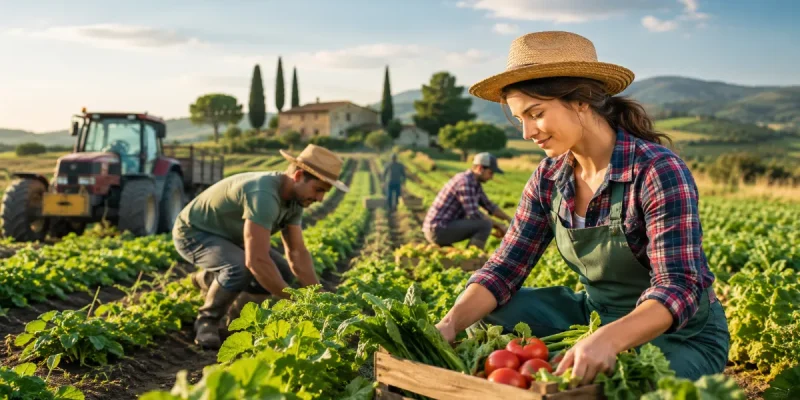

Italy is one of the world’s great agricultural nations the largest wine producer in the world, the second largest olive oil producer, and a global leader in fruit, vegetables, and specialty food products. In 2026, Italy’s agriculture sector employs over 1.3 million workers and accounts for more than €60 billion in annual output. For overseas workers and EU citizens seeking employment in a country with EU legal protections, a rich cultural environment, and genuine career development opportunities, Italy’s agricultural sector offers a wide range of roles across all skill levels from seasonal harvest workers to farm managers and agri-technology specialists.
💰 Salary & Pay Rates (2026)
Average Agricultural Worker Monthly Pay
€1,100–€1,400
CCNL Agriculture Collective Agreement · 2026
Hourly Rate (Seasonal)
€8.50 – €11.00/hr
Above Italy’s minimum wage · overtime paid at 1.25x
Seasonal Harvest Worker
€900–€1,200
per month
Tractor / Machine Operator
€1,300–€1,700
per month
Farm Supervisor
€1,600–€2,200
per month
Agronomist / Farm Manager
€2,200–€3,500
per month
🌍 Why Italy’s Agricultural Sector Is Worth Considering
Italy’s agricultural sector is not simply a temporary employment destination it’s a genuinely diverse industry that employs everyone from seasonal grape pickers earning daily wages to data-driven precision agriculture specialists managing thousands of hectares with GPS-guided machinery. The sector spans 14 million hectares of farmland across regions as different as the Po Valley’s intensive grain and dairy farms, Tuscany’s famous wine estates, Sicily’s vast citrus and vegetable growing operations, and the Trentino-Alto Adige’s world-class apple orchards. Each region has its own employment calendar, dominant crops, and working conditions.
For non-EU workers, Italy operates the Decreto Flussi (Flows Decree) system, which sets annual quotas for non-EU workers to enter Italy for employment with agriculture typically receiving one of the largest quota allocations of any sector. In 2025, over 82,000 non-EU agricultural work visas were allocated under the Flows Decree. If you’re applying from outside the EU, this is the primary legal route to working in Italian agriculture, and the process while not instantaneous is well-established and managed by Italian consulates in your home country.
EU citizens including Romanians, Bulgarians, Poles, and other Eastern European nationals who make up the largest share of agricultural workers in northern Italy can work without any permit process. Romanian nationals alone account for over 30% of Italy’s registered agricultural workforce and have established well-trodden seasonal migration routes, particularly for grape and apple harvests in the north and tomato harvests in Apulia and Campania in the south.
The combination of EU employment law protections, the CCNL Agriculture collective bargaining agreement (which sets minimum wages, working hours, and rest periods for all agricultural workers), and Italy’s social security system (INPS) means that legally employed agricultural workers in Italy have meaningful rights and protections a significant advantage over informal agricultural employment in non-EU countries. Meal contributions, transport allowances, and access to accommodation on larger farms are additional practical benefits widely provided by Italian agricultural employers.
💡 Decreto Flussi: Key Dates to Know
The Flows Decree application window typically opens in early spring. Applications are submitted by Italian employers on behalf of non-EU workers through the Italian Immigration Portal (portaleimmigrazione.it). The process requires a confirmed job offer from an Italian employer before the application opens. Start building employer contacts well in advance January to February to be ready when the decree opens.
🌾 Types of Agricultural Jobs Available
📋 Requirements & Qualifications
Italy’s agricultural sector is genuinely accessible to workers at all qualification levels. Entry-level harvest roles require almost no prior qualifications, while management and technical roles demand specific credentials. Here is a clear breakdown by role type.
1
Legal Right to Work in Italy
EU/EEA citizens can work in Italy without any permit register with the local anagrafe (registry office) and INPS within 3 months of arrival. Non-EU citizens require a work visa obtained through the Decreto Flussi system or other applicable visa categories. Your employer initiates the work permit application on your behalf through the Italian Immigration Portal. Working without proper documentation in Italy carries serious legal consequences always ensure your employment is fully regularised before beginning work.
2
Physical Fitness for Field Work
Harvest and field work in Italy is physically demanding particularly during the summer months in southern Italy, where temperatures regularly exceed 35°C. Workers spend long hours bending, lifting, carrying, and working in open fields. Physical fitness and stamina are genuine requirements, not formalities. Workers with back conditions or mobility limitations should opt for roles in food processing, packing, or farm administration rather than field harvesting. Employers providing accommodation typically conduct a brief health assessment on arrival.
3
Basic Italian Language (Helpful, Not Always Mandatory)
Contrary to what many assume, basic Italian is not a strict requirement for most harvest and field roles particularly in regions like Trentino-Alto Adige and Emilia-Romagna, where employers are experienced in managing multilingual workforces. However, knowing basic Italian phrases for safety instructions, daily task communication, and interacting with supervisors makes an enormous practical difference to your day-to-day experience and increases your chances of being selected for supervisory or repeat-hire roles in subsequent seasons.
4
Agricultural Machinery Licence (For Operator Roles)
Tractor and agricultural machinery operation in Italy requires a specific licence the patente per trattore (tractor driving licence) or the relevant machinery operator certificate issued under Italian safety regulations. Candidates applying for mechanised farming roles must hold a valid licence from their home country that is recognised under EU or bilateral agreements, or must obtain an Italian qualification after arrival. Unlicensed machinery operation is illegal under Italian workplace safety law and results in significant fines for both the worker and employer.
5
Degree in Agronomy or Agricultural Sciences (For Management)
Farm Manager, Agronomist, and Agri-Tech roles in Italy typically require a degree in Agraria (Agricultural Sciences), Scienze e Tecnologie Agrarie, or a related field from a recognised university. Italian public universities Università di Bologna, Università di Padova, and Università degli Studi di Milano have strong agricultural faculties. Candidates with equivalent foreign degrees must have their qualification recognised through the Italian MIUR’s declaration of value process before applying for positions that list a degree as a mandatory requirement.
6
Health & Safety Certificate (Sicurezza sul Lavoro)
Italian law (D.Lgs. 81/2008) mandates that all workers receive basic workplace health and safety training before beginning work. In the agricultural sector, this is a 4-hour or 12-hour course depending on the risk level of the specific role. Reputable employers provide and cover the cost of this training as part of the onboarding process. If an employer does not provide this training, that’s a warning sign about their compliance standards generally. The certificate is issued in Italian, but training is often available in Romanian, Polish, Arabic, and English at larger agricultural employers.
7
Codice Fiscale (Italian Tax Code)
Every worker in Italy must have a Codice Fiscale (equivalent to a national insurance or tax identification number) before beginning legal employment. EU citizens can obtain one free of charge at any Agenzia delle Entrate office in Italy upon presenting their passport or national ID. Non-EU workers receive their Codice Fiscale as part of the residence permit process. Without a Codice Fiscale, your employer cannot register you with INPS (the Italian social security system) or process your payroll legally.
⚡ In-Demand Skills Across the Sector
Italy’s agricultural sector in 2026 spans everything from traditional manual labour to cutting-edge precision agriculture technology. Here’s what employers are looking for across the different tiers of the industry.
🌿 Field & Harvest Skills
Experienced grape harvesters and vine pruners are among the most sought-after workers in Italian agriculture. Vine pruning carried out between January and March requires a specific technique that directly affects the following year’s yield and wine quality. Workers who can demonstrate pruning experience are preferred for repeat contracts at the same estate and often receive slightly higher daily rates than general harvest workers. Italian wine estates, particularly in Chianti, Barolo, and Amarone zones, are selective about who handles their vines.
🚜 Mechanisation & Agri-Tech
Precision agriculture is transforming Italy’s larger arable farms particularly in the Po Valley, which produces wheat, corn, and soybeans at industrial scale. GPS-guided machinery, drone-based crop monitoring, and IoT soil sensors are now common on progressive Italian farms. Workers and technicians who combine traditional agricultural knowledge with digital tool proficiency are among the highest-paid in the sector. The Italian government’s Piano Nazionale di Ripresa e Resilienza (PNRR) is directing significant funding into agricultural digitalisation through 2026–2027, creating new technical roles at a rate the sector has not seen before.
🏭 Food Processing & Agri-Business
Italy’s agri-food processing sector which transforms raw agricultural products into the cheeses, wines, cured meats, and preserved vegetables that Italy exports globally is a major employer in its own right. Food processing workers who hold a HACCP (Hazard Analysis Critical Control Points) certificate are in demand year-round at cooperatives and processing facilities in Emilia-Romagna (Parmigiano Reggiano, Prosciutto di Parma), Veneto, and Lombardy. These roles are typically less physically demanding than field work, better paid per hour, and offer year-round rather than seasonal employment.
📍 Key Agricultural Regions & Job Hotspots
Tuscany & Piedmont
Wine estates · Premium pay
Sept–Oct peak
Po Valley (Lombardy / Veneto)
Arable farms · Dairy · Year-round
Most permanent roles
Apulia & Campania
Tomatoes · Olives · Citrus
May–Dec season
Trentino-Alto Adige
Apple orchards · Best conditions
Aug–Oct · Top wages
🎁 Benefits & Worker Protections
Legal employment in Italy’s agricultural sector comes with a comprehensive set of rights and practical benefits under the CCNL Agriculture collective agreement and Italian labour law. Here’s what you’re entitled to.
💰
Guaranteed Minimum Wage Under CCNL Agriculture
The CCNL (Contratto Collettivo Nazionale di Lavoro) Agriculture collective agreement sets legally binding minimum pay rates, working hours, and conditions for all agricultural workers in Italy EU and non-EU alike, once legally employed. The agreement is renegotiated periodically by Coldiretti, Confagricoltura, and agricultural trade unions. Your contract must reference the CCNL Agriculture and your pay must meet or exceed the applicable category minimum. Keep a copy of your signed contract at all times.
🏠
Accommodation & Meals (Many Employers)
Large agricultural operations particularly wine estates, apple farms in Trentino, and agroturismo-linked farms typically provide accommodation for seasonal workers, either in converted farm buildings (cascine), dormitory-style workers’ housing, or caravans on-site. Meal contributions or a mensa (canteen) are provided at many employers. The quality varies considerably, and it’s worth asking specifically about accommodation standards before accepting a contract. Accommodation is sometimes deducted from wages at regulated rates check your contract carefully.
🏥
Access to Italian National Health Service (SSN)
Once registered with INPS and legally employed, all workers in Italy regardless of nationality are entitled to register with the Servizio Sanitario Nazionale (SSN), the Italian national health service. Registration gives you access to a general practitioner (medico di base), emergency treatment, prescription medication at subsidised rates, and specialist referrals. For seasonal workers, some ASL (local health authority) offices offer simplified registration processes specifically for agricultural workers during peak season.
📅
Paid Annual Leave & Public Holidays
Full-time agricultural workers in Italy are entitled to a minimum of 26 days of paid annual leave per year under the CCNL Agriculture. Italy also has 12 national public holidays, which are paid or compensated with additional pay under the collective agreement. For seasonal workers on short-term contracts, leave entitlement is calculated proportionally based on the number of days worked typically accrued at around 1 day per 13 days of work.
🇪🇺
EU Residency Pathway for Non-EU Workers
Non-EU workers who maintain 5 years of legal, continuous residence in Italy through a combination of seasonal and longer-term work permits may apply for EU long-term resident status under Italian and EU law. Many non-EU agricultural workers from Morocco, India, Senegal, and Eastern European non-EU countries have used the agricultural sector as an entry point into Italy and subsequently built careers in food processing, agri-business, or completely different sectors after obtaining longer-term residency status.
📈
Pension Contributions & INPS Benefits
Italian social security contributions (paid by both employer and employee on every paycheck) accumulate towards an Italian pension entitlement, unemployment benefit (NASPI or DISOCCU for agricultural workers), and sickness benefits. Even seasonal workers who work in Italy for as few as 51 days per year can qualify for DISOCCUPAZIONE AGRICOLA a form of unemployment benefit paid by INPS at the end of the agricultural season. This is a specific and valuable benefit unique to the Italian agricultural sector that provides additional income during the winter off-season months.
📨 How to Apply for Agricultural Jobs in Italy
Finding legitimate agricultural work in Italy requires using the right channels. The market is unfortunately a target for exploitation of uninformed workers using verified sources and understanding the visa process before you commit to anything is essential.
Register on Italian & European Job Portals
Cliclavoro.gov.it is Italy’s official national employment portal managed by the Ministry of Labour. Regioni Lavoro portals (each Italian region has its own) list agricultural vacancies by region and season. EURES (eures.europa.eu) the European Employment Services network is particularly useful for EU citizens seeking agricultural placements in Italy with structured employer contacts. InfoJobs.it and Indeed.it carry private sector listings including agri-food processing and farm management roles.
Contact Italian Agricultural Cooperatives Directly
Italy’s agricultural sector is heavily cooperative-structured. Organisations like Coldiretti (coldiretti.it), Confagricoltura, and CIA Agricoltori Italiani are the major representative bodies and can connect you with member farms that are recruiting. Cooperative groups like Apofruit (Emilia-Romagna fruit), Mela Val Venosta (South Tyrol apples), and Consorzio Vino Chianti Classico regularly advertise directly for seasonal workers on their own websites and through their member networks.
Use WWOOF Italy for Organic Farm Experience
WWOOF Italia (World Wide Opportunities on Organic Farms) connects volunteers with organic farms across Italy in exchange for food and accommodation. While not a paid employment route, WWOOF is an excellent way to build Italian agricultural experience, improve your Italian, and develop the farm contacts that can lead to paid roles in subsequent seasons. Many WWOOF alumni have been hired as paid seasonal workers by the same farms they first visited as volunteers.
For Non-EU Applicants: Follow the Decreto Flussi Process
The Decreto Flussi is the primary legal route for non-EU agricultural workers entering Italy. The process: (1) secure a job offer from an Italian employer before the decree opens; (2) your employer submits the application through portaleimmigrazione.it when the decree opens; (3) if approved, you collect your visa from the Italian consulate in your home country; (4) enter Italy and convert the visa to a residence permit within 8 days. Never pay an intermediary to find you a Decreto Flussi placement legitimate placements are facilitated by employers, not paid to visa brokers.
Prepare a Simple CV with Relevant Experience
For field and harvest roles, a one-page CV listing your previous agricultural work experience (even informal), any relevant licences (tractor, forklift), your available dates, and contact information is sufficient. For technical and management roles, include your education, any HACCP, agronomic, or machinery certifications, and specify your Italian language level. Including a short covering note in Italian even basic Italian signals genuine commitment to working in the Italian market and is noticed positively by hiring managers at larger operations.
Apply & Search on These Platforms:
📅 Posted
June 2026 (Active)
💼 Type
Seasonal & Permanent
📊 Annual Openings
300,000+
🌿 Ready to Work in Italian Agriculture?
From the vineyards of Tuscany to the apple orchards of South Tyrol, Italy’s agricultural sector offers work for all skill levels with EU legal protections and a genuine pathway to longer-term residency. Register on the official portals, contact cooperatives directly, and start building your Italian agricultural career.



Leave a Comment