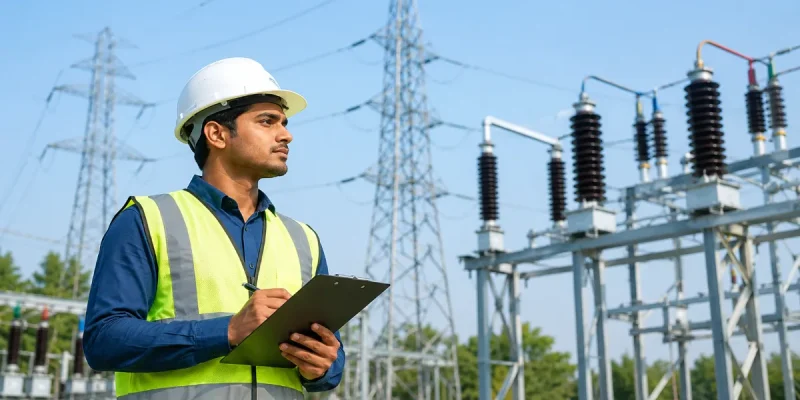

Junior Engineer (Electrical) is one of the most consistently recruited government engineering posts in India in 2026, with thousands of vacancies generated annually across central government departments, state PSUs, defence establishments, railways, power sector corporations, and municipal bodies. For Diploma holders in Electrical Engineering and B.E./B.Tech Electrical graduates, a JE (Electrical) government post offers exceptional job security, a competitive 7th CPC pay structure, comprehensive social security benefits, and a clear promotion pathway to Assistant Engineer, Executive Engineer, and beyond. This comprehensive guide covers every major recruiting organisation, salary details, eligibility criteria, exam patterns, and the precise preparation strategy needed to crack the top JE Electrical examinations in India.
📋 Key Recruitment Overview & Notification Details
Top Recruiting Bodies
SSC JE · RRB JE · UPPCL · CPWD
ssc.nic.in · indianrailways.gov.in · uppcl.org
Post Category
Group-B & Group-C
Central & State Government Gazetted / Non-Gazetted
SSC JE App Fee
₹100
SC/ST/Women: ₹0
Exam Mode
CBT Online
Paper I + Paper II
Annual JE Openings
5,000+
Electrical branch
Age Limit
18–32 Years
with category relaxation
💰 Salary & Pay Structure Across Major Organisations (2026)
SSC JE Electrical (Level 6)
₹35,400
Basic Pay (7th CPC) · SSC JE in CPWD, MES, CWC
Gross Monthly (approx.)
₹52,000 – ₹70,000
Including DA, HRA, TA & other allowances
SSC JE / CPWD / MES
₹35,400–₹1,12,400
Level 6 (7th CPC)
RRB JE Electrical
₹35,400–₹1,12,400
Level 6 (7th CPC)
UPPCL JE Electrical
₹44,900–₹1,42,400
Level 7 (UP Govt)
PSPCL / BSPHCL JE
₹30,000–₹48,000
State PSU scale
⚡ About the Junior Engineer (Electrical) Post
The Junior Engineer (Electrical) is a technical government post responsible for the planning, execution, maintenance, and supervision of electrical engineering works in government establishments. Depending on the recruiting organisation, a JE Electrical may be responsible for maintaining electrical installations in government buildings (CPWD), managing signalling and traction systems on railways (RRB/Indian Railways), supervising power distribution networks (UPPCL, BSPHCL, PSPCL), overseeing electrical works at defence installations (MES Military Engineering Services), or maintaining electrical infrastructure at ports, waterways, and public sector undertakings. The role sits at the execution level of the engineering hierarchy and has direct supervisory responsibility over technical staff, contractors, and workmen.
The Staff Selection Commission Junior Engineer (SSC JE) examination is the most widely known and most applied-for JE Electrical recruitment route at the central government level. SSC JE recruits JEs for departments including the Central Public Works Department (CPWD), Military Engineering Services (MES), Central Water Commission (CWC), Department of Posts, Farrakka Barrage Project, and Border Roads Organisation (BRO). The Railway Recruitment Board (RRB JE) is equally significant, recruiting Electrical JEs for the traction, signalling, general services, and workshop branches of Indian Railways. Together, these two examinations account for the majority of central government JE Electrical vacancies in any given year.
State-level JE Electrical recruitment is conducted by State Public Service Commissions, State Electricity Boards and Power Corporations (UPPCL in UP, BSPHCL in Bihar, PSPCL in Punjab, MSEDCL in Maharashtra, TNEB in Tamil Nadu), State PWD departments, and municipal corporations. These state-level posts often offer pay scales equivalent to or higher than central government posts in high-income states, and crucially offer postings close to the candidate’s home state a significant practical advantage over central government transfers. Several state electricity corporations have moved to a higher Level 7 pay structure for JEs, making them among the best-paying technical government posts at this qualification level.
The promotion pathway for a Government JE (Electrical) is well-defined at central and most state government organisations JE (Level 6) → Assistant Engineer / AE (Level 7 or 8) → Executive Engineer / EE (Level 10 or 11) → Superintending Engineer (Level 12) → Chief Engineer (Level 13). Promotions happen through DPC (Departmental Promotion Committee) based on seniority-cum-merit, or through LDCE (Limited Departmental Competitive Examination) for merit-based accelerated promotion. JEs who complete a B.E./B.Tech in Electrical while in service or who pass the AMIE examination can access the direct promotion to AE cadre faster than those without a degree-level qualification.
⚠️ Multiple Recruiting Bodies: Each Has Its Own Notification
JE Electrical government jobs in India are recruited through dozens of different bodies SSC, RRB, UPPCL, BSPHCL, PSPCL, DRDO, SAIL, NTPC, BHEL, state PSCs, and many more. Each has its own notification, eligibility criteria, exam pattern, syllabus, and application portal. Always monitor multiple portals simultaneously (ssc.nic.in, rrbcdg.gov.in, uppcl.org, your state PSC/electricity board website) and apply to every notification for which you are eligible. Appearing in multiple examinations simultaneously is both permitted and recommended it maximises your chances significantly.
🏢 Top Recruiting Organisations & Bodies
📋 Eligibility Criteria
JE Electrical eligibility varies across recruiting bodies, but the core requirements are consistent. Here is the comprehensive breakdown based on the SSC JE, RRB JE, and major state JE recruitment patterns.
1
Nationality: Indian Citizen
Candidates must be Indian citizens. For SSC JE and RRB JE (central government posts), candidates must also be either Indian citizens or subjects of Nepal/Bhutan, or Tibetan refugees who came to India before January 1962, or persons of Indian origin who have migrated from specified countries with the intention of permanently settling in India. For state-level JE posts (UPPCL, state PWD, state PSC-recruited JEs), domicile of the respective state is typically required alongside citizenship. Verify the nationality clause in each specific notification before applying.
2
Age Limit: 18 to 32 Years (Varies by Organisation)
SSC JE: 18–32 years for most departments; 18–27 years for certain departments like CWC and CPWD. RRB JE: 18–33 years. UPPCL JE: 21–40 years (with UP domicile). Age relaxation as per GoI rules: SC/ST 5 years; OBC 3 years; PwD (General) 10 years; Ex-Servicemen military service period + 3 years; Government employees up to 5 years. The age is calculated as of the closing date of the online application. Note that the maximum age varies significantly between departments even within the SSC JE notification always check the specific department-wise age limit table in the official notification.
3
Educational Qualification: Diploma or Degree in Electrical Engineering
For SSC JE and RRB JE, the standard qualification is a 3-year Diploma in Electrical Engineering from a recognised institution or a B.E./B.Tech in Electrical Engineering. Both diploma and degree holders are eligible for the same JE post there is no pay difference or preference between them at entry level for SSC JE and RRB JE. For state electricity board JEs (UPPCL, PSPCL, BSPHCL), some notifications specifically require a B.E./B.Tech in Electrical Engineering check each notification. AMIE (Associate Member of the Institution of Engineers India) holders with Electrical branch are also eligible. Final-year students who will complete the qualifying examination before the document verification stage can apply in most central government JE notifications.
4
Physical Fitness & Medical Standards
Most JE Electrical posts do not have the stringent physical standards of police or defence posts. Standard government medical fitness no disability that prevents normal technical work, reasonable vision (corrected vision is typically acceptable unlike police posts), and no condition that prevents working on electrical installations is the general requirement. For RRB JE posts in certain operational categories (e.g., Electrical/TRD or Electrical/TRS in railways), specific vision standards are prescribed. MES JE posts may have higher medical standards given the field/defence setting. Review the medical requirements in the specific notification for your target post.
5
Character Certificate & Background Verification
All selected JE candidates undergo character and antecedent verification before final appointment. A clean criminal record is required any involvement in criminal cases involving moral turpitude, serious offences, or dishonesty is disqualifying. Minor civil disputes, traffic challans, or family disputes that did not result in criminal conviction generally do not affect appointment. Government service candidates must produce a No Objection Certificate (NOC) from their current employer as part of the document verification process.
6
Special Requirements by Department
For MES (Military Engineering Services) JEs, candidates may be required to undertake field postings in remote/border areas including North-East, J&K, and Leh-Ladakh. For DRDO JE/Technician posts, security clearance from intelligence agencies is conducted before appointment. For RRB JE in Electrical/TRD (Traction Distribution), basic understanding of 25kV AC traction systems is expected in technical knowledge. For PGCIL (Power Grid Corporation of India) trainee JE posts, knowledge of EHV (Extra High Voltage) transmission systems is a significant advantage. Always read the specific departmental requirements within the broader notification to understand any special posting or technical knowledge conditions.
📝 SSC JE Exam Pattern & Syllabus (Most Important Exam)
The SSC JE is a two-paper examination. Paper I is an online CBT (Computer Based Test) conducted first; Paper II is a conventional (descriptive) written exam for candidates shortlisted from Paper I. Both papers are critical.
📋 Core Technical Syllabus: Electrical Engineering (Both SSC JE & RRB JE)
Basic Electrical
Ohm’s Law, Kirchhoff’s Laws, Network Theorems, AC Circuits, Power Factor
Electrical Machines
DC Machines, Transformers, Induction Motors, Synchronous Machines
Power Systems
Generation, Transmission, Distribution, Switchgear, Protection, Relay
Electronics
Semiconductors, Diodes, Transistors, Amplifiers, Op-Amps, Digital
Measurements
Instruments, Bridges, Transducers, CRO, Energy Meters, CT/PT
Control Systems
Transfer Function, Block Diagram, Bode Plot, Root Locus, Stability
💡 Subject-Wise Preparation Strategy
JE Electrical government exams are genuinely competitive the SSC JE typically attracts 5–8 lakh applicants for a few thousand vacancies. A subject-focused, time-bounded preparation plan is essential. Here is the strategy that toppers consistently use.
1
Electrical Machines & Power Systems: Your Highest-Weightage Sections
Electrical Machines (DC machines, transformers, induction motors, synchronous generators/motors) and Power Systems (generation, transmission, distribution, protection) together account for approximately 40–50% of the technical marks in SSC JE and RRB JE Electrical papers. These are your highest-return investment areas. For Electrical Machines, master the equivalent circuit models, torque-speed characteristics, losses and efficiency calculations, and the operating principles of each machine type. For Power Systems, focus on per-unit systems, fault analysis (symmetrical and asymmetrical), protection relay principles, and the basics of switchgear and circuit breakers. Use A.K. Sawhney’s Electrical Machines and C.L. Wadhwa’s Electrical Power Systems as primary references for these topics.
2
Basic Electrical & Network Theory: Master the Fundamentals First
Basic Electrical theory Ohm’s Law, Kirchhoff’s Laws, network theorems (Thevenin, Norton, Superposition, Maximum Power Transfer), AC circuit analysis, resonance, three-phase circuits, and power factor is the foundation of all other technical sections. Questions from this section appear regularly in both SSC JE and RRB JE and are among the most predictable in terms of question types. Spend the first 4–6 weeks of your preparation ensuring these fundamentals are rock solid before moving to more complex topics. V.K. Mehta’s Principles of Electrical Engineering and Electronics is the standard reference for this section at diploma level.
3
Electronics, Measurements & Control Systems
These three sections together typically contribute 25–30% of technical marks. For Electronics: focus on semiconductor diode characteristics, BJT and MOSFET configurations and biasing, operational amplifiers (inverting, non-inverting, summing, differentiating, integrating), and basic digital electronics (logic gates, flip-flops, number systems). For Measurements: types of instruments (PMMC, MI, electrodynamometer), energy meters, CT and PT ratios, and bridge circuits (Wheatstone, Maxwell, Schering). For Control Systems: transfer functions, block diagram algebra, signal flow graphs, time response analysis, frequency domain (Bode plots, Nyquist), and stability criteria (Routh-Hurwitz). Control Systems is highly mathematical and often the section where diploma candidates struggle most begin with the conceptual understanding before the mathematical derivations.
4
General Awareness: Consistent Daily Reading, Maharashtra / State GK for State Exams
General Awareness in SSC JE covers current affairs (last 6–12 months), static GK (Indian History, Geography, Polity, Economy, Science & Technology), and energy sector-specific GK (National Solar Mission, PM KUSUM scheme, renewable energy targets, major power project milestones). Read The Hindu or PIB daily for 20–30 minutes and use a monthly GK capsule from Adda247, Testbook, or Gradeup. For state-level JE exams (UPPCL, state PWD), state-specific GK covering state history, geography, major schemes, and state power sector developments is additionally tested. Lucent’s GK remains the most widely used static GK reference for government exam preparation.
5
Previous Year Papers & Mock Tests: Non-Negotiable Final 3 Months
Solving previous year SSC JE and RRB JE Electrical question papers (at least 10 years back) is the single most effective preparation activity in the final 3 months before the examination. These papers reveal the actual question patterns, topic weightages, difficulty levels, and frequently repeated question types that no textbook or coaching material can fully replicate. Take full-length timed mock tests on platforms like Adda247, Testbook, and BYJU’s Exam Prep under examination conditions (no interruptions, 2-hour window). Analyse every wrong answer the same day and identify whether the error was conceptual, computational, or time-management-related. Target 65%+ in Paper I mock tests consistently before appearing for the actual examination.
⚡ Technical Skills That Strengthen Your Profile & Career
Beyond examination performance, these practical technical competencies are what make a Government JE (Electrical) genuinely effective in service and more likely to receive strong performance ratings that accelerate promotion to AE and EE.
🖥️ Core Electrical Engineering Practice
Indian Electricity Rules 1956 (now largely updated under the Electricity Act 2003 and Central Electricity Authority regulations) govern the installation, operation, and maintenance of electrical systems in government buildings and public spaces. A JE (Electrical) who is familiar with CEA (Technical Standards for Construction of Electrical Plants and Electric Lines) Regulations 2010, IE Rules for safety in construction and maintenance, and the National Building Code (NBC 2016) electrical provisions brings immediate practical value. Earthing system design pipe earthing, plate earthing, ring earthing specifications and transformer maintenance routines are regular site responsibilities for JEs in CPWD and state PWD postings.
💻 Digital Tools & Software
Government electrical departments are progressively digitalising their work processes. CPWD has been implementing Building Information Modelling (BIM) for new construction projects, and JEs who can work with AutoCAD Electrical for single-line diagrams, cable schedules, and panel layouts bring immediate productivity value to their divisions. State electricity boards use GIS mapping for distribution network asset management JEs comfortable with GIS-based outage management systems and distribution network mapping are among the most valued in operational roles. For Railway JEs, the Railway’s computerised maintenance management system (CMMS) and SCADA systems for traction substations are standard digital tools in the role.
📋 Contracts, Estimation & Supervision
In CPWD and state PWD roles, the JE is the first-level officer responsible for measuring and recording work done by contractors in the official Measurement Book (MB) a legal document that forms the basis of contractor bill payments. Errors or irregularities in MB entries are serious departmental matters. Understanding the CPWD Specifications for Electrical Works, the Delhi Schedule of Rates (DSR) or State DSR for rate analysis, and GeM portal procurement procedures for materials and services are practical competencies that senior officers actively look for when assessing a JE’s readiness for AE-level responsibility. JEs who take these administrative and financial responsibilities seriously not just the technical ones are the ones who progress fastest in the government engineering hierarchy.
📍 Posting Locations & Departments
Delhi & NCR
CPWD · MES · Central Ministries
Most central postings
Pan-India (Railways)
All 18 Zones · Traction · General Services
RRB JE postings
State Power Sector
UPPCL · BSPHCL · PSPCL · MSEDCL
Home state posting
Defence / MES / BRO
Border Areas · Cantonments · Field
Field duty allowances
🎁 Service Benefits & Perks
A Government JE (Electrical) appointment comes with a comprehensive benefits package that goes well beyond the basic salary. Here is the complete picture of what you receive as a permanent central or state government technical employee.
🏥
CGHS Medical Coverage for Family
Central Government JEs (SSC JE posted in CPWD, MES, CWC, BRO) and their dependants receive comprehensive CGHS (Central Government Health Scheme) coverage at 300+ empanelled hospitals across India. All medically necessary treatments OPD, diagnostics, hospitalisation, surgery, prescribed medications are covered at zero or minimal cost. The annual cost avoided by a family of four using CGHS premium plan services easily exceeds ₹40,000–₹60,000. Railway JEs receive equivalent coverage through the Railways’ own healthcare system (Railway hospitals and health units). State PSU JEs receive state government health schemes or group medical insurance depending on the organisation.
🏠
General Pool Residential Accommodation (GPRA)
Central Government JEs are eligible for General Pool Residential Accommodation (GPRA) at subsidised licence fees. While actual allotment depends on the waitlist in your pay level and posting city, JEs posted in Delhi, Mumbai, or other metros who receive a government quarter save ₹15,000–₹40,000 per month in market rent. Where a quarter is not allotted, HRA at 24% (X-city), 16% (Y-city), or 8% (Z-city) of basic pay is received for a Level 6 JE on ₹35,400 basic, Delhi HRA alone is ₹8,496/month. Railway JEs receive railway colony accommodation at their posting station in most cases.
✈️
Leave Travel Concession (LTC)
Central Government JEs receive LTC (Leave Travel Concession) for travel to their home town every 2 years and All India LTC every 4 years, with travel costs reimbursed at economy air or AC railway class. For a family of four, one LTC cycle can reimburse ₹60,000–₹1,20,000 in travel costs. Railway JEs receive a pass (free travel on Indian Railways) for themselves and their family one of the most valuable perquisites in the entire central government employment ecosystem. Railway employees typically use their passes for significant personal travel savings throughout their service period.
💳
NPS Pension + Gratuity & Other Retirement Benefits
JEs recruited after January 2004 are covered under NPS (National Pension System) with a 14% employer contribution by the Central Government. Over a 30-year service period, this employer NPS contribution represents substantial retirement wealth creation. Gratuity of 15 days pay per year of service (maximum ₹20 lakh, tax-free) is paid on retirement or death in service. Central Government Group Insurance Scheme (CGEGIS) provides term life insurance at highly subsidised premium rates. For Railway JEs, the Railways’ Provident Fund (Railway Contributory Provident Fund for NPS-covered staff) and the Railway Gratuity Fund provide additional retirement security.
📈
Promotion Pathway: JE to AE to EE
The promotion pathway for a CPWD/MES JE (Electrical): JE (Level 6, ₹35,400–1,12,400) → Assistant Engineer (Level 8, ₹47,600–1,51,100) → Executive Engineer (Level 11, ₹67,700–2,08,700) → Superintending Engineer (Level 12) → Chief Engineer (Level 13). DPC-based promotion to AE typically takes 8–12 years; LDCE route can reduce this to 5–7 years for high-performing JEs. For Railway JEs, the promotion to Section Engineer (SE) and Junior Engineer Grade II is similarly structured with annual increments and DPC timelines defined in the Railway Establishment Manual. State PSU JEs have equivalent ladders defined by their respective service rules.
🎓
Study Leave, Training & Professional Development
Government JEs are eligible for study leave to pursue B.E./B.Tech, M.Tech, MBA (relevant disciplines), or AMIE programmes at recognised institutions. Departmental training at the CPWD Training Institute (Gurgaon), NTTF, Railway Training Institutes, and MES training establishments is provided with full pay throughout. Specialist technical training in energy auditing, green building certification (GRIHA, LEED), and SCADA systems is provided to JEs working in relevant specialisations. Foreign training deputation for exceptional performers particularly in the energy sector is available through NIFM, World Bank programmes, and bilateral technical cooperation agreements between India and other countries.
📨 How to Apply
JE Electrical government applications are submitted exclusively online. Here is a precise step-by-step guide to applying for SSC JE, RRB JE, and state-level JE Electrical vacancies without errors.
Monitor All Relevant Portals Simultaneously
Bookmark and check the following portals weekly for JE Electrical notifications: ssc.nic.in (SSC JE), rrbcdg.gov.in or your regional RRB portal (RRB JE), uppcl.org (UPPCL JE), your state PSC website, your state electricity board website, and npcilpunjab.gov.in/careers for NPCIL. Sign up for email/SMS notifications wherever available. Sarkari Result (sarkariresult.com) and Freshersworld aggregate notifications across all boards useful as a secondary check but always verify from the official source before applying. Multiple JE Electrical notifications from different bodies frequently overlap in their application windows manage your calendar carefully to avoid missing any deadline.
Apply on the Official Portal with Correct Details
For SSC JE: register at ssc.nic.in, create a One-Time Registration (OTR) profile, and apply from the “Apply” section when the notification opens. For RRB JE: apply at your designated RRB’s website (rrbcdg.gov.in, rrbmumbai.gov.in, etc.) you must apply only to one RRB. For UPPCL: apply at uppcl.org. Fill your name, date of birth, educational qualification, and category exactly as they appear in your original documents any discrepancy at the document verification stage causes disqualification regardless of merit. Upload the photo and signature in the specified file size and format. Confirm payment of application fee and save the confirmation page.
Prepare Documents for Verification in Advance
Keep the following original documents and multiple attested copies ready: 10th, 12th, Diploma, and Degree mark sheets and certificates; a caste certificate (if applicable) and OBC non-creamy layer certificate dated within the last year; domicile certificate (for state posts); Aadhaar card; passport-size photographs (minimum 10 copies); No Objection Certificate (if currently in government service); and certificate of completion of apprenticeship or industrial training (if claiming additional marks under apprenticeship preference). Apply for any outstanding documents particularly OBC non-creamy layer certificates, which have an annual validity well in advance of the document verification stage.
Download Hall Ticket & Prepare for Exam Day
Admit cards for SSC JE are released at ssc.nic.in typically 1–2 weeks before the examination. For RRB JE, admit cards are released at the respective RRB’s website. Download and print two copies of the admit card. Carry it along with a valid photo ID (Aadhaar card, Voter ID, or Passport) to the examination centre. Arrive at least 60 minutes before the examination start time CBT exam centres have strict entry cut-off times after which no candidate is permitted. Carry your own stationery (pen, pencil, eraser) for Paper II (descriptive) but not electronic devices for CBT Paper I.
Apply to Multiple Examinations Simultaneously
The single most effective strategy for securing a JE Electrical government job is applying to every examination for which you meet the eligibility criteria simultaneously and without prioritisation. SSC JE, RRB JE, UPPCL JE, BSPHCL JE, state PWD JE, and central PSU JE (NTPC, BHEL, SAIL, DRDO, ISRO) can all be applied to in the same preparation cycle. The technical syllabus overlaps significantly across most of these examinations. Appearing in multiple exams not only improves your probability of selection but also builds valuable examination experience that improves your performance in each subsequent attempt. Track every notification, apply on time, and treat each exam with equal seriousness.
Official & Helpful Links:
📅 Updated
June 2026 (Active)
💼 Post Type
Permanent · Group-B/C
📊 Annual Openings
5,000+ Electrical
⚡ Build a Secure Engineering Career in Government Service
India’s government JE (Electrical) posts offer Level 6 pay, CGHS healthcare, housing, LTC, and a clear promotion pathway to AE and Executive Engineer. Apply across multiple examinations, master the technical syllabus, and begin your preparation with previous year papers. Consistency and breadth of application are the two factors that most reliably produce success in government JE recruitment.





Leave a Comment