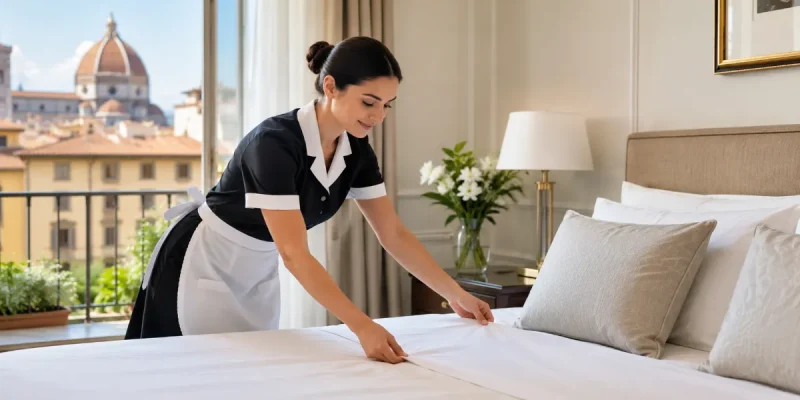

Italy is one of Europe’s most consistent sources of full-time employment in the cleaning and housekeeping sector. With over 70 million tourists annually, a world-class hotel industry, a large healthcare system, and millions of square metres of commercial and residential property requiring professional maintenance, Italy’s demand for cleaning and housekeeping workers is structural and year-round not just seasonal. For EU citizens who can work freely and for non-EU applicants eligible for the Decreto Flussi, this guide covers everything you need to find, apply for, and secure a well-paying, legally protected cleaning or housekeeping role in Italy.
💰 Salary & Pay Rates (2026)
Average Monthly Salary
€1,100–€1,400
CCNL Cooperative & Turismo · Italy 2026
Hourly Rate Range
€8.00 – €11.50/hr
Luxury hotels & healthcare pay at the upper end
Domestic / Household
€900–€1,100
per month
Hotel / Tourism
€1,100–€1,400
per month
Healthcare / Hospitals
€1,250–€1,600
per month
13th / 14th Month Pay
Yes, CCNL
Christmas + holiday bonus
🌍 Why Italy Is a Strong Choice for Cleaning & Housekeeping Workers
Italy’s cleaning and housekeeping sector is governed by the CCNL (Contratto Collettivo Nazionale di Lavoro) the national collective bargaining agreement that sets legally binding minimum wages, working hours, leave entitlements, and overtime rates for all workers in the sector. Unlike many countries where employer goodwill determines employment conditions, in Italy these terms are enforceable by law. A full-time cleaning worker in Italy is entitled to a 13th month salary (tredicesima, paid in December), and often a 14th month salary depending on their specific CCNL, making the annual salary considerably higher than the monthly figure suggests.
The Italian tourism and hospitality sector the world’s fifth largest by revenue employs hundreds of thousands of cleaning and housekeeping workers across hotels, agriturismo (farm tourism), bed and breakfasts, and luxury villas. Rome, Venice, Florence, and the Amalfi Coast are global tourism destinations that generate year-round housekeeping demand at 4 and 5-star properties. For workers with prior hotel housekeeping experience, Italy’s top hotel groups NH Hotels, Marriott Italia, Best Western Italia, and independent luxury properties are consistently hiring and offering packages that include accommodation and meals on-site for live-in positions.
Italy’s national healthcare system (Servizio Sanitario Nazionale or SSN) is the second largest employer in the cleaning sector, with hundreds of hospitals, clinics, and long-term care facilities across the country requiring teams of cleaners and housekeeping staff. Healthcare cleaning roles in Italy are among the best-paid in the sector typically €1,250–€1,600 per month under the CCNL Cooperative and are managed by large facility management companies including Sodexo Italia, ISS Italia, and Manutencoop. These roles offer year-round employment, structured working hours, and often a formal career pathway into supervisory positions.
For non-EU workers, the Decreto Flussi remains the primary legal route into Italian employment including the cleaning sector. Italy typically allocates a significant share of its annual work visa quota to domestic and cleaning work, with specific quotas for workers from countries that have bilateral labour agreements with Italy. The process is employer-led and requires a confirmed job offer before the decree window opens making early employer contact (January–February each year) essential for non-EU applicants hoping to enter through this route.
💡 13th & 14th Month Salary: Understanding Italian Pay
In Italy, the stated monthly salary is your base. On top of this, you receive a tredicesima (13th month salary equivalent to one month’s pay) in December, and under many CCNLs a quattor-dicesima (14th month salary) in June or July. This means your actual annual earnings are 13–14 times your monthly base significantly more than the monthly figure alone suggests. Always ask about whether both bonuses apply when evaluating a job offer.
🏢 Top Employers in Italy
📋 Requirements & What Employers Look For
Cleaning and housekeeping roles in Italy have a genuinely accessible entry bar no formal qualifications are required for most positions. But Italian employers, particularly in the hotel, healthcare, and luxury property sectors, do have specific and consistent expectations. Here is a clear breakdown.
1
Legal Right to Work in Italy
EU/EEA citizens can work in Italy without any permit simply register with the local Anagrafe (registry office) and INPS within 3 months of starting work to ensure your employment is fully regularised. Non-EU citizens require a work and residence permit (Permesso di Soggiorno per Lavoro), which is obtained through the Decreto Flussi (Flows Decree) system an employer-led process managed through the portaleimmigrazione.it portal. Always work with a legitimate contract informal undeclared work (lavoro in nero) carries serious legal consequences for both worker and employer under Italian labour inspection law.
2
No Formal Qualifications Required (Entry Level)
The large majority of Italian cleaning and housekeeping roles from hotel room attendants to office cleaners to villa housekeepers require no formal academic or vocational qualifications. What replaces qualifications as the primary selection criterion is your work history, references, physical fitness, and reliability. For healthcare cleaning roles managed by Sodexo, ISS, or Manutencoop under public tender contracts, a brief HACCP food hygiene awareness course (available online for €20–30) and a health and safety at work certificate (Formazione Sicurezza D.Lgs. 81/2008, typically 4–8 hours) may be required as part of the onboarding process both funded by the employer in most cases.
3
Basic Italian Language (Very Helpful, Often Essential)
Unlike some other European markets, basic Italian is genuinely important for most full-time cleaning and housekeeping roles in Italy. Safety notices, product instructions, supervisor briefings, and interactions with hotel guests or hospital patients are conducted in Italian. At a minimum, functional Italian enough to understand task instructions, read cleaning product labels, and communicate with your team is strongly recommended before starting work. FM companies operating large multi-national teams (Sodexo, ISS) sometimes have bilingual supervisors, but private household and hotel roles almost always require at least basic Italian conversational ability. Completing an A1/A2 Italian language course before arrival significantly improves both your hiring prospects and your daily working experience.
4
Physical Fitness & Reliability
Full-time cleaning and housekeeping in Italy is physically demanding a hotel housekeeping shift typically requires 8–12 room turnovers per day at 5-star properties, and commercial cleaning involves extended periods of mopping, vacuuming, scrubbing, and equipment operation. Italian employers particularly in the hotel sector place very high value on punctuality and reliability. Unannounced absences are managed formally under the CCNL disciplinary procedures, and accumulated unexplained absences are grounds for termination. A reference from a previous employer that specifically confirms your reliability and punctuality is the most useful document you can bring to any Italian cleaning interview.
5
Codice Fiscale (Italian Tax Identification Number)
Every worker in Italy must have a Codice Fiscale before legal employment can begin. EU citizens can obtain one free of charge at any Agenzia delle Entrate office or Italian consulate in their home country, presenting only a valid passport. Non-EU workers receive their Codice Fiscale as part of the residence permit (permesso di soggiorno) process. Without a Codice Fiscale, your employer cannot register your employment contract with INPS (the Italian social security agency) or process payroll in your name. Apply as early as possible after your decision to work in Italy the process is straightforward but you need time to receive the physical card.
6
Prior Cleaning Experience (Preferred for Hotel & Healthcare)
5-star hotels and healthcare cleaning contracts in Italy prefer candidates with at least 6–12 months of prior professional cleaning experience. For private household roles and smaller employers, character and willingness to learn matter more than experience. If you’re new to professional cleaning, start with a smaller hospitality or domestic household role, build a reference, and progress to the higher-paying hotel or corporate contracts within 6–12 months. Italian hotel groups specifically value experience with high-standard room turnover technique, luxury linen handling, and guest privacy protocols that distinguish premium hotel housekeeping from general cleaning.
7
Clean Criminal Record (For Healthcare & Live-In Roles)
Healthcare cleaning employers and families hiring domestic housekeepers for live-in or regular household roles typically request a Certificato del Casellario Giudiziale (Italian criminal record certificate) or an equivalent certificate from your home country. This is a straightforward administrative requirement not a presumption of wrongdoing and is standard practice across the sector. Italian criminal record certificates are issued by the local Tribunale (courthouse) within 3–5 working days. Foreign certificates may need to be apostilled; check the specific employer requirement before applying.
⚡ Skills That Get You Hired & Promoted in Italy
Italy’s hospitality and cleaning sector has high standards particularly in the hotel and healthcare segments. These specific competencies are what distinguish candidates who get hired immediately from those who are passed over, and what earn you faster progression to supervisory roles paying €1,600–€2,000 per month.
🧹 Professional Cleaning Standards
Italian 4 and 5-star hotel housekeeping standards are aligned with the best in Europe. Room turnovers at luxury properties are timed and quality-inspected a standard “occupied room” clean is expected in 25–30 minutes to a defined checklist standard. Chemical safety knowledge under the EU’s REACH regulation (knowing which products are safe to mix, correct dilution ratios, safe storage, and disposal) is an assessment item at FM company onboarding. Colour-coded cleaning systems (different coloured cloths and mops for different areas bathroom, floor, surfaces) are standard in all healthcare environments and most professional hospitality settings in Italy. If you can demonstrate this knowledge in your interview, it immediately signals professional competence to Italian hotel and healthcare hiring managers.
🏨 Hospitality & Guest Service Standards
Italian luxury hotel guests many of them international, high-value tourists have elevated privacy expectations. A housekeeper who moves quietly, works without disturbing guests, handles personal belongings with complete discretion, and always reports found items through the correct channel is considered far more valuable than one who is simply fast. Turn-down service is expected at 4 and 5-star properties throughout Italy learning the specific preparation sequence (bed fold, lighting adjustment, bathroom presentation, chocolates placement) is a skill that demonstrates professional hospitality experience. Italian hotel groups specifically prefer candidates who can articulate their understanding of guest privacy as a professional value, not just a procedural requirement.
📋 Organisation & Supervisory Skills
Progression from Room Attendant or Cleaner to Housekeeping Supervisor (Governante di Piano) or Team Leader in Italian hotels and FM companies is realistic within 18–24 months for reliable, skilled workers. The supervisory pay uplift is meaningful €1,600–€2,000 per month versus €1,100–€1,400 at operative level. Supervisory skills that Italian employers specifically look for include the ability to conduct room quality inspections against a standard checklist, manage daily trolley inventory accurately, coordinate a small team across multiple floors, and handle room reassignments and priority changes as guest check-in/check-out patterns shift throughout the day. HACCP food safety awareness particularly relevant for housekeeping teams who handle in-room dining items is an additional qualification that broadens your role scope and value.
📍 Best Cities & Regions
Rome (Roma)
Hotels · Vatican area · Offices
Most openings
Milan (Milano)
Corporate FM · Healthcare · Fashion
Year-round demand
Venice, Florence, Amalfi
Luxury hotels · Tourism peak
Premium hotel pay
Tuscany & Lake Como
Villas · Agriturismo · Live-in
Accommodation included
🎁 Benefits & Legal Employment Rights in Italy
Italy’s CCNL collective agreements and national labour law give cleaning and housekeeping workers comprehensive rights and benefits that apply equally to EU and legally employed non-EU workers. Here is the full picture.
💰
13th Month Salary (Tredicesima) & Annual Bonus
Every Italian cleaning and housekeeping worker under the CCNL receives a tredicesima an extra month’s salary paid in December as a Christmas bonus. Under many sector CCNLs (particularly CCNL Cooperative Sociale and CCNL Turismo), a 14th month salary is also paid in June or July as a summer holiday bonus. For a worker earning €1,200/month, this represents €1,200–€2,400 in additional annual compensation beyond the monthly salary a genuinely significant benefit that is often underappreciated when comparing Italian wages to other countries.
📅
Paid Annual Leave: 26 to 30 Days
The CCNL for cleaning and housekeeping workers in Italy provides a minimum of 26 days paid annual leave per year significantly above Italy’s statutory minimum of 20 days. Under the CCNL Turismo (applicable to hotel housekeeping workers), full-time employees receive 26–30 days annual leave depending on their category and seniority. Italy also has 12 national public holidays which are either paid leave days or result in an additional day’s pay if worked. Annual leave must be agreed with the employer at least two weeks in advance, and unused leave entitlement cannot simply be forfeited it must be compensated if employment ends.
🏥
Italian National Health Service (SSN) Access
All workers legally employed in Italy including non-EU workers on valid residence permits are entitled to register with the Servizio Sanitario Nazionale (SSN) by presenting their employment contract and residence permit to the local ASL (Azienda Sanitaria Locale). SSN registration gives you access to a general practitioner (medico di base), emergency treatment, specialist referrals, and prescription medication at heavily subsidised rates. For a physically demanding job like cleaning and housekeeping, having free access to occupational health services and medical treatment from day one is a genuinely important benefit.
🏠
Accommodation & Meals for Live-In and Hotel Roles
Live-in domestic housekeeping positions common in Tuscany, Lake Como, Rome, and the Amalfi Coast typically include free accommodation and meals as part of the employment package, in addition to the cash salary. Under the CCNL Collaboratori Domestici (domestic workers collective agreement), the value of accommodation and board is calculated and must not reduce the cash component below the minimum CCNL wage. For hotel housekeeping roles at larger chains, staff cafeterias providing subsidised or free meals are standard. Eliminating accommodation and food costs from your budget can effectively double the value of the cash salary in high-cost Italian cities.
📈
TFR (Trattamento di Fine Rapporto): Severance Fund
The TFR (Trattamento di Fine Rapporto) is a uniquely Italian employment benefit your employer sets aside approximately one month’s salary per year of service in a dedicated fund in your name. This fund is paid out to you when your employment ends (regardless of the reason resignation, contract end, or termination). For a worker employed for 3 years at €1,200/month, this represents approximately €3,600 received at departure. You can alternatively ask your employer to contribute the TFR to a supplementary pension fund (fondo pensione) rather than keeping it in-house, which offers tax advantages for long-term workers.
🇪🇺
EU Long-Term Residency Pathway (Non-EU Workers)
After 5 years of legal continuous residence in Italy, non-EU workers may apply for EU long-term resident status (Permesso di Soggiorno UE per Soggiornanti di Lungo Periodo). This provides near-permanent residency in Italy and significantly improved rights to live and work in other EU member states. For workers from countries with active migration flows to Italy Morocco, Tunisia, Philippines, Ukraine, India, Bangladesh the cleaning and housekeeping sector has historically been one of the primary legal entry points into the Italian labour market and a building block toward long-term European settlement.
📨 How to Apply for Cleaning & Housekeeping Jobs in Italy
Finding legitimate, well-paying cleaning and housekeeping employment in Italy requires using the right channels and understanding the specific dynamics of the Italian labour market for this sector. Here is a step-by-step approach that consistently works.
Register on Italian & European Job Portals
Infojobs.it is Italy’s largest general job board and carries thousands of cleaning and housekeeping listings at any time. Indeed.it (Italian version) is also widely used. For EU citizens, EURES (eures.europa.eu) provides a structured job matching service for cross-border EU employment, with direct contacts at Italian employment centres (Centri per l’Impiego). Subito.it Italy’s Gumtree equivalent carries many domestic and private household housekeeping ads that don’t appear on formal job boards. For hotel and FM company roles, search directly on the employer’s career portals (it.sodexo.com, iss-it.com, manutencoop.it).
Contact Hotels & FM Companies Directly
Italy’s hotel and FM sectors respond well to direct contact. Email the Human Resources department of NH Hotels Italia, Best Western Italia, or independent luxury properties in your target city with a concise Italian-language email (even a basic one) attaching your CV. For FM companies, contact their regional or provincial offices directly Sodexo, ISS, and Manutencoop all have regional HR functions that manage local hiring for their cleaning contracts. Direct approaches in February–March (before the summer peak season) and September (before the autumn conference season) are best-timed for hotel hiring cycles.
Prepare a CV in Italian (Or Bilingual)
For Italian employers, a CV in Italian or at minimum a bilingual Italian/English version signals genuine commitment to working in Italy and significantly improves your response rate. Italian CV format typically includes a photo (unlike UK and Australian practice), personal details including date of birth and nationality, work history in reverse chronological order, and a brief summary of your cleaning experience and language skills. Keep it to one page. Use free tools like Europass (the EU standard CV format) if you’re unsure about Italian CV conventions Europass is widely recognised by Italian employers and is available in Italian at europass.europa.eu.
For Non-EU Applicants: Follow the Decreto Flussi Process Carefully
The Decreto Flussi (annual immigration flows decree) is Italy’s quota system for non-EU workers. The process: (1) secure a confirmed job offer from an Italian employer; (2) your employer submits the Nulla Osta (work authorisation) request through portaleimmigrazione.it when the decree opens (usually early spring); (3) once approved, collect your Visto di Ingresso (entry visa) from the Italian consulate in your home country; (4) enter Italy and apply for your Permesso di Soggiorno within 8 working days of arrival at a Post Office (Ufficio Postale) that handles immigration applications. Legitimate employers do not charge workers for this process if an intermediary asks for significant upfront fees, that is a red flag.
Know & Assert Your CCNL Rights
Before starting any cleaning or housekeeping job in Italy, identify which CCNL governs your employment it should be stated in your contract. The most relevant CCNLs for cleaning workers are: CCNL Imprese di Pulizia e Multiservizi (for FM companies), CCNL Turismo (for hotel housekeeping), and CCNL Collaboratori Domestici (for private household workers). Each has a published minimum wage scale, working hour limits, and leave entitlement. You can verify your contract against the relevant CCNL on the INPS website or through CGIL, CISL, or UIL Italy’s three major trade unions all of which offer free advice to workers, including migrants, on their employment rights and contract terms.
Apply & Search on These Platforms:
📅 Posted
June 2026 (Active)
💼 Type
Full-time · Permanent
📊 Annual Openings
80,000+ Nationwide
🚀 Ready to Build Your Career in Beautiful Italy?
Italy offers EU employment rights, a 13th month salary, genuine career progression, and the unique experience of living and working in one of the world’s most remarkable countries. Register on InfoJobs.it, contact hotels and FM companies directly, and take the first step toward your Italian career.



Leave a Comment